

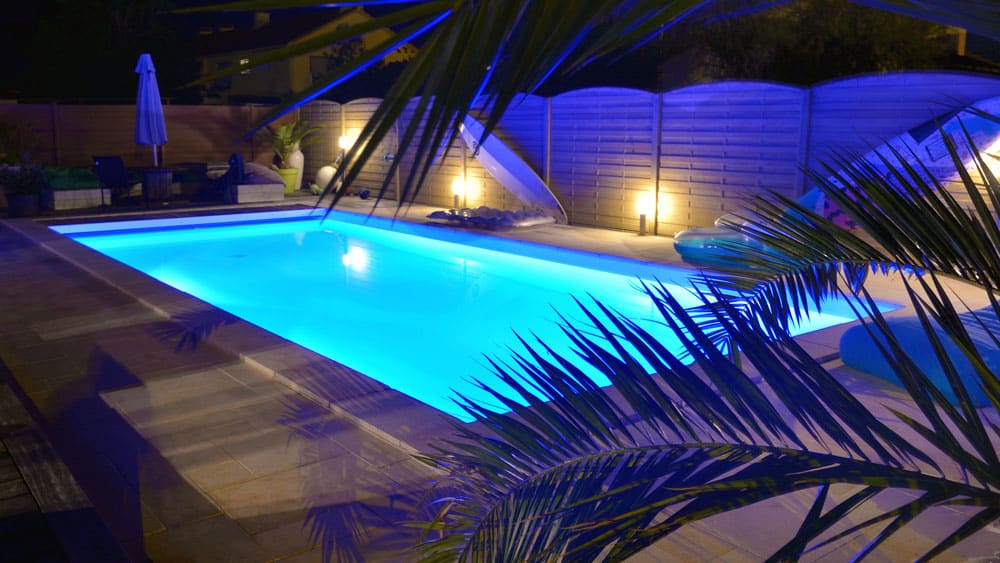
Have you ever considered how vital underwater swimming pool lights are for both safety and aesthetics? Designed to illuminate the swimming pool for swimmers while improving visibility for those outside the water, these lights serve a dual purpose as essential safety equipment and a way to beautify your backyard oasis.
To ensure optimal safety, properly installed swimming pool lights should be connected to a dedicated circuit protected by a Ground Fault Circuit Interrupter (GFCI). This device monitors the electrical current flowing through the circuit and immediately cuts off power if it detects any unintended path—such as through a person—helping prevent potentially fatal shocks. Regular testing of the GFCI is crucial to maintaining this protection. For more guidance, see our related article, “Pool and Spa Lights Not Working? Check Your GFCI First!”
Inside the fixture, all conductors are sealed in epoxy resin, making it extremely difficult for water to contact any electrical components. However, if the fixture overheats from the bulb’s heat, the protective resin can melt or become compromised. That’s why it’s important to avoid turning on a swimming pool light above water unless you are briefly testing a newly replaced bulb. When the fixture is submerged, the water acts as a natural radiator, cooling the interior and preventing overheating.
Recent advancements in swimming pool lighting have greatly improved safety standards. In Austin, Texas, for example, swimming pool lights are now commonly required to operate at 12 volts. As your swimming pool light ages and eventually fails, it should be replaced with a low-voltage model, which requires a transformer to step voltage down from 120 volts to a safer 12 volts. This additional component is affordable and significantly reduces electrical output, lowering the risk of dangerous shock.
Imagine a situation where stray voltage is present due to a malfunctioning GFCI in a swimming pool equipped with a 12-volt light. In that case, a swimmer could potentially tolerate the shock. However, if a 120-volt light were installed instead, the outcome could be far more severe.
Today’s swimming pool lights offer a wide range of vibrant color options thanks to innovations like LED technology and color-changing light engines. Flexible fiber optic lighting can even contour along the shape of the swimming pool, adding dramatic visual appeal. These modern advancements not only enhance the beauty of your swimming pool but also contribute to a safer swimming environment.
Swimming pool lights have become safer, more durable, and an essential feature of the backyard landscape. While their design has made repairs more straightforward, it is still best to consult a licensed appliance installer or electrician to ensure the entire system is safe and up to code. Ultimately, the primary purpose of any swimming pool lighting system is safety—so light up your evenings and enjoy your swimming pool with confidence and peace of mind.